high country: critical relations
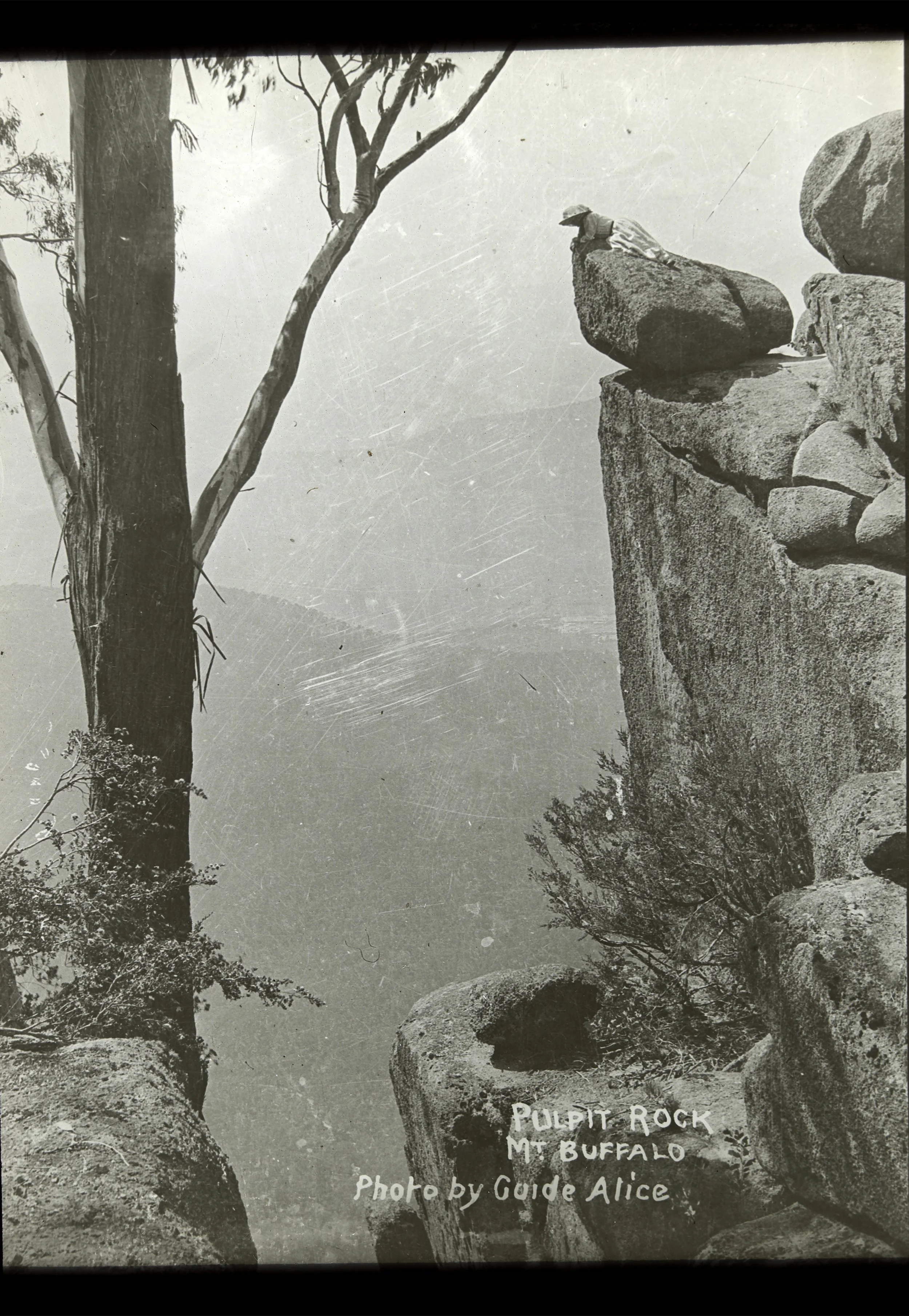
Pulpit Rock, Mt Buffalo by Alice Manfield (Guide Alice), [ca. 1890 - ca. 1930], Archival image, Courtesy of the State Library of Victoria.
By Clare McCracken and Heather Hesterman with Andrew Ferris
Once settlers arrived in northeastern Victoria, Tubberlungener (Mount Buffalo) was documented by painters such as Nicholas Chevalier and Eugene von Guerard, as well as photographers from the 1860s, as a site of sublime beauty —a pristine wilderness that should be protected. While this visual culture contributed to the protection of the Mountain through the establishment of the Mount Buffalo National Park in 1898, it also erased the significant occupation of the mountain by the Mogullumbidj People, their care for Country, and the mountain’s exceptional cultural importance to the First Peoples of Australia. ‘High Country: Critical Relations’ utilises performance and costume to interrogate the critical relations between archives and settler-ways of seeing and being in the Victorian High Country.
The artists would like to acknowledge the Taungurung as the Traditional Custodians of Tubberlungener. We pay our deepest respects to Elders past and present and acknowledge their connection and custodianship of the Mountain as well as their extraordinary survival and resistance in the face of the settler-based practices that we explore through these artworks. We also pay our deepest respect to the other First Peoples of the region, who have a sacred connection to the Mountain and its surrounds.
This is an ongoing and growing project. Reach out to the artists if you would like to know when it is being exhibited. Exhibited at Wangaratta Gallery, 2024 and Library at the Dock Gallery, 2025 and published in Rawgue Magazine issue #6 2026. By Clare McCracken and Heather Hesterman with Andrew Ferris.
High Country Costumes
To help us bridge the gap between the historical and contemporary visual culture of Tubberlungener (Mount Buffalo), we crafted these High Country costumes. The jacket of the costume is inspired by the men and women captured in Alice Manfield’s photography (the first settler-woman to live on the mountain and extensively photograph it). Made from recycled safari jackets with imperial buttons, the jackets have been dyed at the base to match the granite rocks of the mountain. Screen-printed alpine lichen also works its way up the base of the jacket and arms. Lichen inexorably changes the chemical weathering of rocks as it excretes various organic acids, particularly oxalic acid, which dissolves minerals. As it does so, it creates soil that fosters life in the form of plants. The safari jackets are therefore being conceptually eroded by the lichen. The safari jacks are paired with a puffer scarf (the atire of contemporary hikers and mountain climbers), covered in granite frottage and a large skit that mirrors some of the outfits in Alice’s photography but also the sails of the first European ships that brought convicts, soldiers, migrants, and introduced species to the continent and the moutain.
Bogong, Pygmy, Sallee and Sallow: critical relations
Inspired by some of the first photographs of settlers exploring Mount Buffalo National Park by Alice Manfield, the artists use costumes, movement, and the camera shutter to erase themselves—settlers—from the heart of the photo. Tubberlungener (Mount Buffalo) is a place of critical relationships profoundly affected by colonisation and climate change. Endemic species, such as the Bogong, Pygmy, Sallee, and Sallow, some of which are found nowhere else in the world, are critically endangered. Even the mountains’ distinctive granite rocks, exposed to the intense heat of contemporary bushfires, have been accelerated, spalling under thermal pressure and washing down the mountain. In this quadtych, fire-impacted granite removed from clogged waterways, performance and extreme heat applied to a photographic print have been used to challenge the visual culture of Australian national parks, which depicts intrepid settlers at the heart of the image, while also acknowledging their lasting impact.


Bogong, Pygmy, Sallee and Sallow: critical relations, 2025. By Clare McCracken, Heather Hesterman & Andrew Ferris. 3 digital print on Ilford smooth cotton rag, 1 digital print on Ilford smooth cotton rag exposed to extreme heat. Found granite gravel washed off the mountain after bushfires and removed from creeks by volunteers. Each 57cm x 84.5cm. Installation views below.
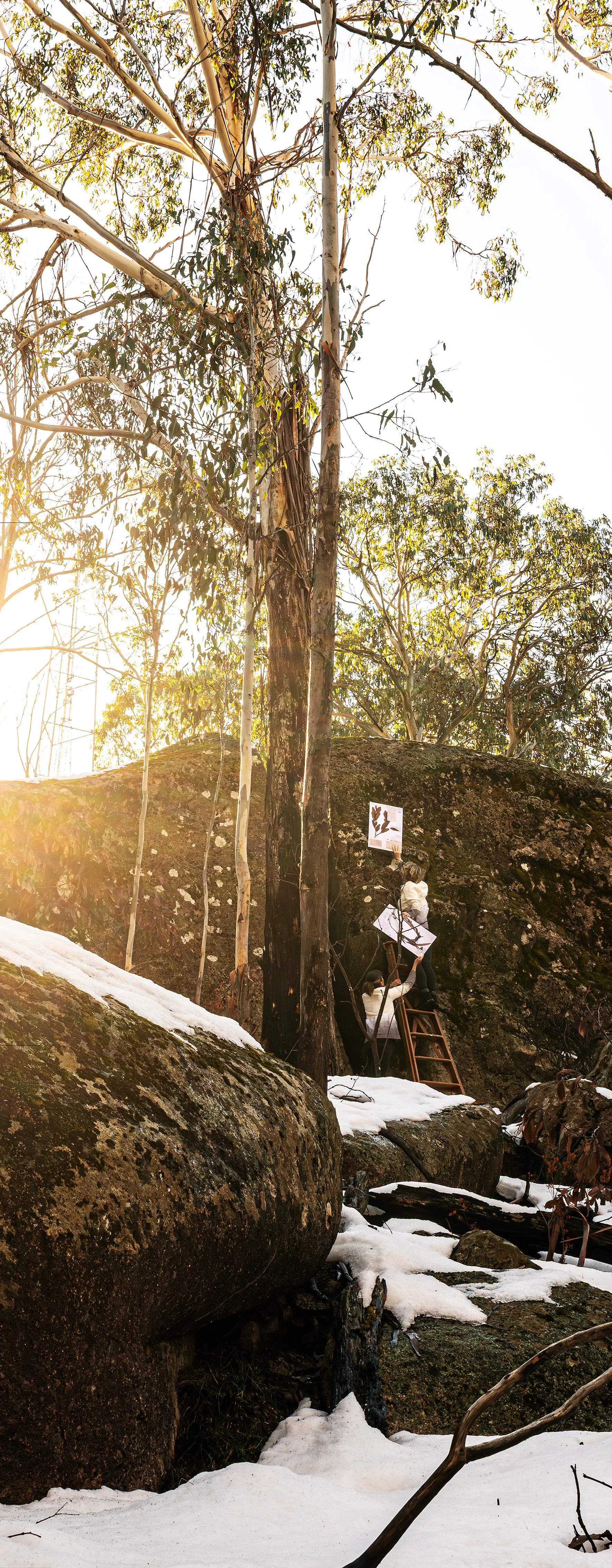
TIPPING POINT
Baron Ferdinand von Mueller was appointed the government botanist for the colony of Victoria in 1853. For his first expedition, he rode on horseback to Tubberlungener (Mount Buffalo), collecting what western science considered ‘undiscovered’ species. As von Mueller travelled, he famously scattered blackberry seeds. Like many regions of Australia, invasive species cause significant ecological damage on Tubberlungener (Mount Buffalo). In particular, blackberries, deer, rabbits, foxes, and cats. In this action, the artists carry two prints of botanical samples held in the Victorian and NSW herbaria, including one harvested by von Mueller, up Tubberlungener (Mount Buffalo, seeking higher and thus colder ground. These species have been listed as endangered or critically endangered since the colonisation of Australia. Due to climate change, their future remains uncertain. If only settlers responded to climate change with the same care they have invested in their intergenerational archives.