Wild Country: the Ovens River

Wild Country: all that is lost and sometimes found, 2024. By Clare McCracken and Heather Hesterman. Photograph by Andrew Ferris.
By Clare McCracken and Heather Hesterman with Andrew Ferris, Scarlet Sykes Hesterman and Xander Reichard
It is believed that the water flowing through the Ovens River is the same water that has always been on Earth, arriving four and a half billion years ago as the solar system formed. Therefore, the water of the Ovens has moved through the capillaries of plants, nurtured new life in wombs, leisurely advanced through underground aquifers and lapped against tall ships, canoes and bulk carriers. Like the imprint from a child’s hand, or the turbulence of a ship’s wake, water records the past in its molecular architecture; pasts that we may be incapable of seeing or pasts that have been actively erased. Therefore, to think with water - to think with the Ovens River - is to remember.
With impressive granite rocks and majestic river red gums, the Ovens River and its watershed are picturesque, making it a much-loved spot for camping, swimming, paddling, and fishing. However, historical and ongoing ecological impacts, including gold mining (sluicing, dredging and deep deposit), water mining, the violent disruption of Aboriginal cultural practices of care, tree falling and agriculture, have significantly altered its landscape. This exhibition explores the environmental history and social significance of the Ovens River and its watershed through narrative nonfiction writing, participatory arts practices, and documentation of performative fieldwork.
The artists would like to acknowledge the Dhudhuroa, Taungurung, Waywurru, Gunaikurnai, and Jaithmathang as the First Peoples and Traditional Custodians of the upper Ovens River and its watershed. We pay our deepest respects to Elders past and present and acknowledge their connection and custodianship of the River as well as their extraordinary survival and resistance in the face of the settler-based extractionist practices that we explore through these artworks.
To access the narrative nonfiction audiobook that explores the extensive research behind this project, please follow this link. Exhibited at Wangaratta Gallery in 2024, Library at the Dock Gallery in 2025 and shortlisted for the Experimental Print Prize in 2025, The Bowness Photography Prize in 2026. By Clare McCracken and Heather Hesterman with Andrew Ferris, Scarlet Sykes Hesterman and Xander Reichard.
Ground TRUTHING
In the 1930s, ‘Susso workers’ (people who worked for their government ‘sustenance payment’ during the Great Depression) cleared eucalyptus forest in the Ovens Valley to make way for pine plantations. This experimental photographic work by Clare McCracken, Heather Hesterman and Andrew Ferris begins with an archival photo of Susso workers, screen-printed onto eucalyptus ply. The artists shred this print and feed it through a mulching machine, replacing it with a photo of an Ovens Valley pine plantation, digitally printed onto pine plywood made at the local mill. The resulting wood chips are heaped beneath the new print, highlighting the violent relationship between trees and late capitalism, as well as the extractionist rhythms that shape the Ovens River and its watershed. This cycle of death and disaster will be performed 30 times (the life cycle of plantation pine is 30 years) – the wood chip pile growing until it covers the print.
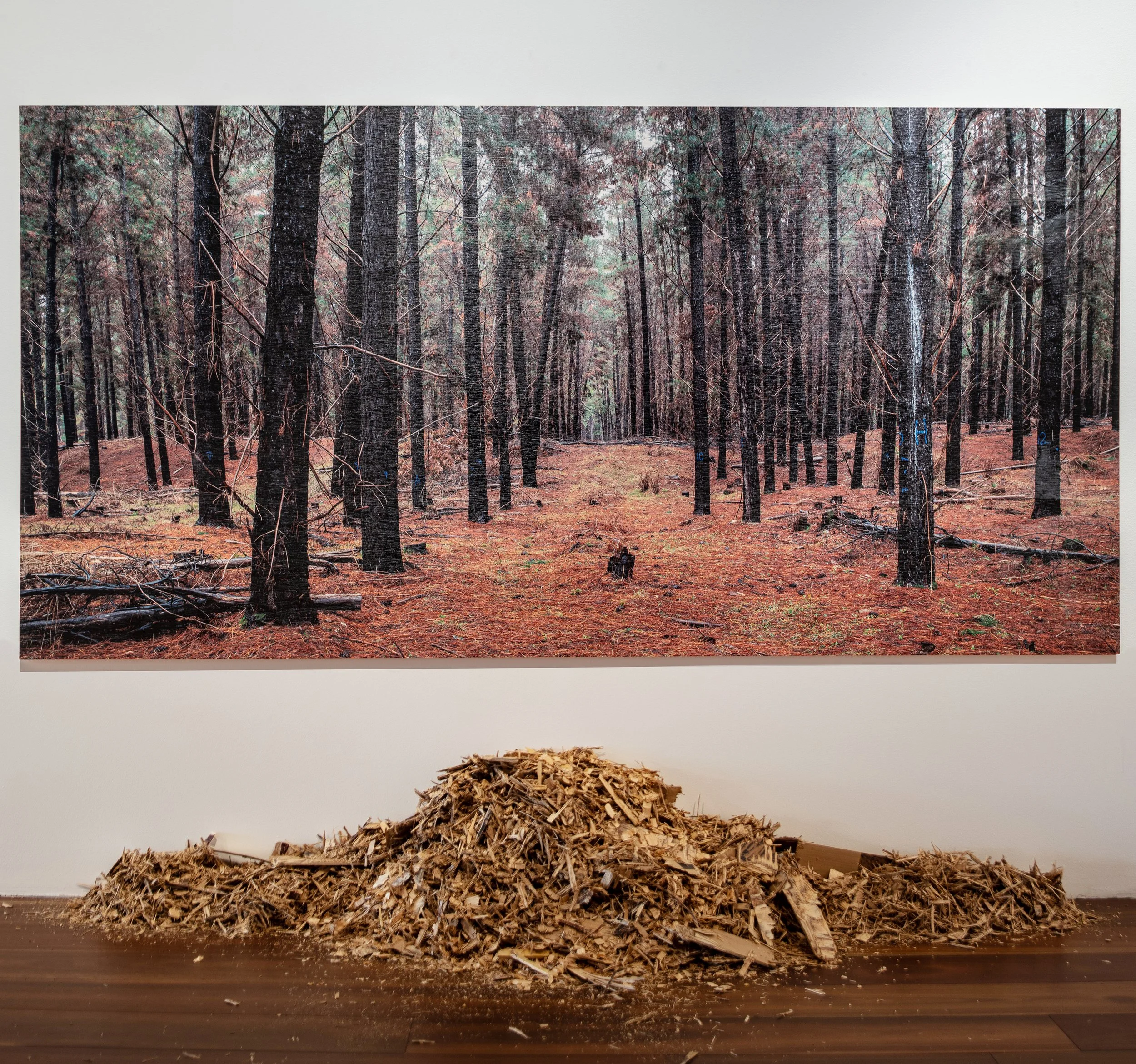
Ground Truthing by Clare McCracken, Heather Hesterman and Andrew Ferris, 2026 ongoing.
All that is lost and sometimes found

Clare McCracken and Heather Hesterman. All that is lost and sometimes found, 2024. Digital print on Ilford Gold, 39 x 26cm. Photograph by Andrew Ferris.
Inspired by the clothing of the first squatters or contemporary farm managers, these costumes bridge the imaginary gap between the ecological history of the Ovens River and its contemporary state. The yellow cuffs and tails reference the DDT that flowed through the land and water system, while their patchworked fabric featuring screenprinted native grasses and detailed with golden quilting represents the loss of native grasses due to settler land use and land management practices including the introduction of hooved animals, mining and dredging, land division into farms, and the violent disruption of cultural burning practices. The River Valley Costumes are made from modified recycled suit jackets and pockets, dyed and screen-printed recycled bedsheets and gold thread embroidery. The artists wore these costumes on a series of walks along the river, carrying native vegetation indigenous to the region in their pockets. In doing so, they momentarily reintroduced the plants that now struggle to grow along the terraformed River.

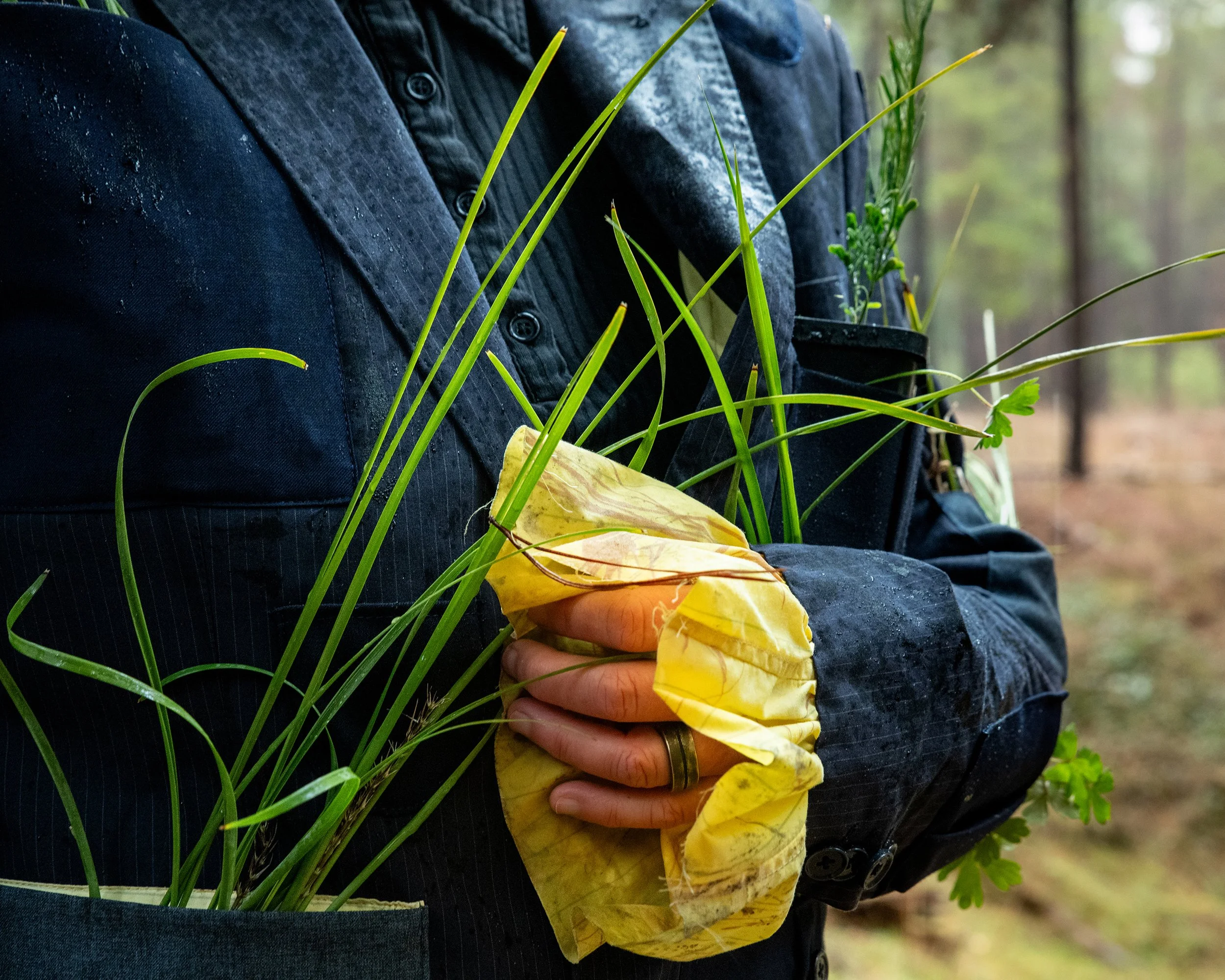

Feral Actions
Clare McCracken and Heather Hesterman. Wild Country: Feral actions, 2024. 1080p, infinite loop. Videography by Scarlet Sykes Hesterman.
In this action, the artists transformed the River Valley costumes into agents of care, filling their pockets with rubbish and the introduced plant species that line the river’s banks. The Ovens River has an impressive history of volunteer-led environmental campaigning, from the anti-sludge campaigners, which grew out of the first gold rush, to the anti-dredge and DDT volunteers (1). Today, volunteers regularly clean, replant and care for the river.
(1) See Lawrence, S and Davies, P 2019, Sludge, La Trobe University Press, Melbourne and Robertson, K 1973 Myrtleford: Gateway to the Alps, Rigby Limited, Hong Kong.

Clare McCracken and Heather Hesterman. Reading Letters to the RIver in our River Vests, 2024. Digital print on Ilford Gold, 100 x 130cm
River Letters
Communities members, prior and during the exhibition, wrote letters to the Ovens River. These letters explored a forgotten history, a memory or an aspiration for the river. In this action Clare and Heather read the letters to the river while wearing their River Vests; vests that were designed to explore the recreational and social importance of the river. When the work was exhibited at the Library at the Dock, audience members wrote letters to the Ovens River or another body of water that was precious to them.

Clare McCracken and Heather Hesterman. River Vests, 2024. Found fishing vests, gold beads and gold cotton.

Left: Letter to Kirah written by Megan Carter, Waywurru Nation, 2024. Right: Letter to the Ovens River written and illustrated by Children from Myrtleford P12 College, 2024.

Left: Letter written to the Ovens River by Dr Helen Haines MP, 2024. Right: Letter to the Ovens River written by EI, 2024.

A gallery visitor adds a letter to the wall, Wangaratta Gallery, 2024.

Left: Letter written to the Ovens River by SMB, 2024. Right: letter written to the Ovens River by antonymous, 2024.

The letter wall installed at Library at the Dock, 2025.
exhibition View Wangaratta Gallery, 2024


